

Dogwood 10 Miler - Race Report
5 months ago
 This morning we had bread and coffee for breakfast, shocking I know. After that we went to the beach…at the Mediterranean Sea! It was a beautiful beach day and I also got a few minutes of reading in. The beach did not have sand; instead it had rock/gravel. I was told that the water was going to be really cold; however, it felt the same to me as a typical day at Virginia Beach. It was a great morning.
 After the beach we drove for a few hours to the city of Avignon. We took a tour of the Pope’s Palace there. For about 100 years (1309-1403) the papacy was actually located in Avignon. 9 Popes actually lived in Avignon, although the final two were actually during a schism and therefore there was actually a Pope in Rome during their ‘reign’ as Pope. We toured the palace and learned a lot about Catholic influence in France. It was interesting to see that many of the statues of statesmen, monarchs, and clergy had their heads chopped off. This was done during the French Revolution. The French Revolution was a time when the French common people stood up to their oppressors, namely, the monarchy and the state church. This was just another reminder of the darkness that has been a part of France for so long. After the palace we drove back to Lyon and checked back into the hotel.
 I woke up feeling great on the 19th, and it ended up being one of my favorite days. We had focused on the Roman history of France the day before and today we focused on the persecution of the Huguenots (the Huguenots were French Protestants). The first thing we did was go to the Musee du Desert (museum of the desert, alluding to the Israelites in the desert in Exodus). The first room we walked into had a giant picture of Martin Luther at the Diet of Worms. (We had not officially gone into the museum yet so I was unaware of the no picture rule they had (there were no signs up either), so I have a picture of the Luther painting but nothing else at this site.)Then I looked around and saw pictures and artifacts of Luther, Calvin, Zwingli and the other reformers. Needless to say I was pretty pumped! The museum was the house of a 17th century Huguenot. We went through the different rooms and saw the many instruments that they used in their secret worship services. One room, the ‘Bible room’, was particularly amazing. It was full of old French Bibles and showed the commitment to Scripture that these believers had. This museum really made me realize how easy we have it and unfortunately, how lightly we can tend to take Scripture. These believers could have easily budged on a few pieces of doctrine and been free from persecution, but instead they stayed faithful and suffered for it. After discussing the museum and it’s implications for our lives we went to lunch.
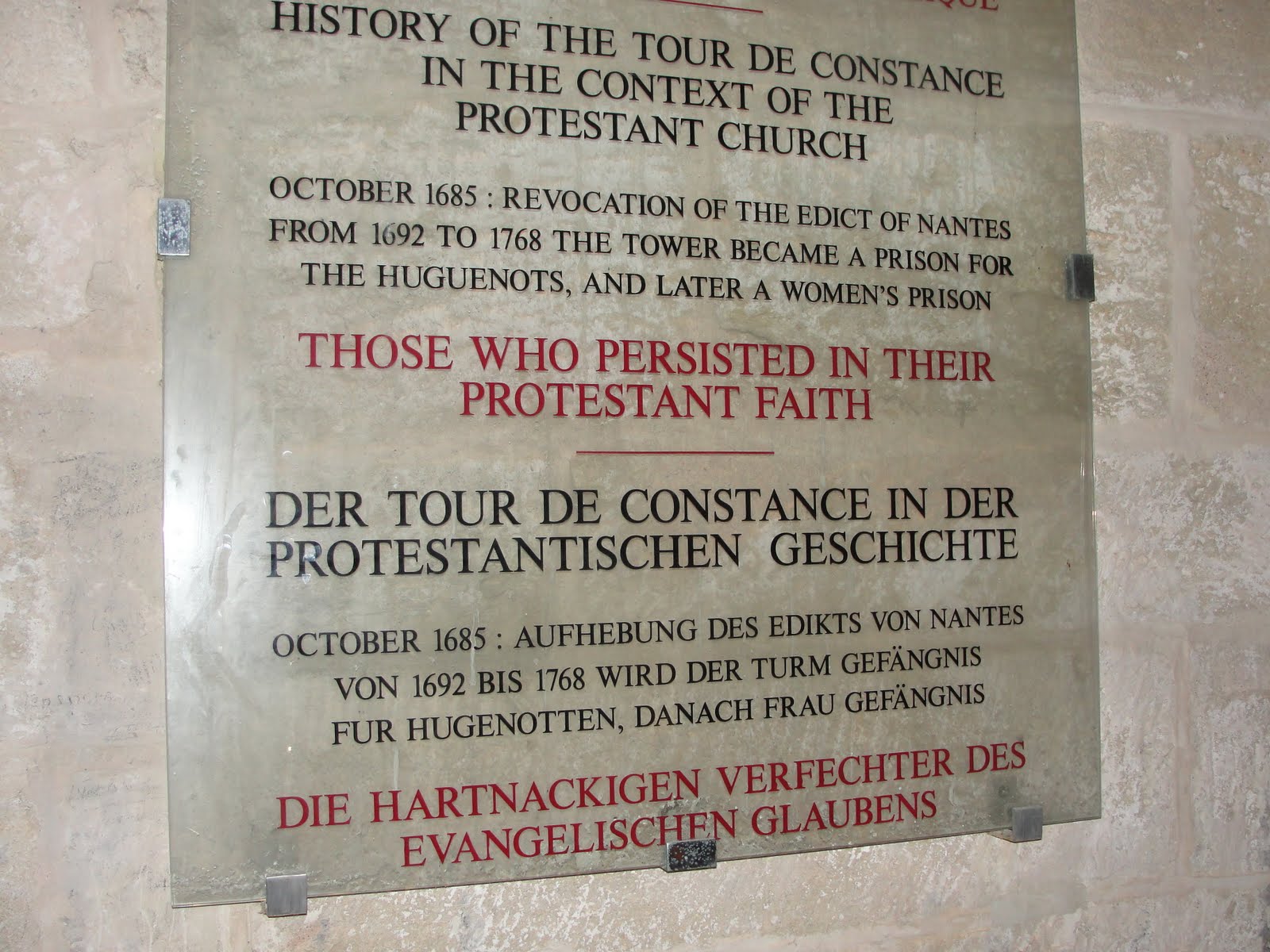 While at the museum we were told about the different forms of persecution. Children were just sent to Catholic school, men were sent to row ships until they recanted, and women were sent to the Tower of Constance (Tour de Constance). The next place we went to was a medieval city that was walled in. Inside the walls was the Tour de Constance. As we walked through the tower we were told multiple stories of martyred women and the lengths some women went to to help their fellow prisoners. It was gross to see the inside of this concrete tower and hear that 40+ women were stuffed into a little room. The conditions were terrible and at times they would do things like shave the women’s heads for humiliation. After walking through the tower we went through the city and I stumbled across another room dedicated to the reformers (bottom picture). After walking around the city a little more we drove to Marseilles and ate a typical French meal and went to the hotel. A day filled with history, theology, and persecution. It left me with much to think about and be thankful for.
 We woke up around 5:20, which was not a problem for me since I had fallen asleep the night before around 8:30. We ate croissants in the center for breakfast and made sandwiches for ourselves for lunch. We the loaded up two vans and headed down three hours south to the Pont du Gard. The Pont du Gard is the site of a Roman aqueduct. We walked through a museum that gave us a very thorough history of how Rome came to rule in southern France and the impact that has on the modern day French. We also learned how they made aqueducts and why there is an aqueduct there. We then left the museum and walked out to where the aqueduct was and saw the beautiful site. It was huge! After taking some pictures we ate lunch.
 After lunch we drove for about 20 minutes to the city of Nimes. In Nimes we visited another Roman amphi- theater, but this one was much larger than the one in Lyon. At the amphitheater we were given little MP3 devices that would guide us through the amphitheater and tell us about the different things that went on there. Not only did this amphitheater hold real gladiator fights, but it also was a place of Christian persecution and martyrdom. This tour reminded me once again of why this area of the world is so lost. I was unaware that intense Christian persecution went all the way back to the 3-4th century in France. I knew of the French Revolution and how the French had harbored hatred for the Catholic Church for hundreds of years prior. I knew there was intense persecution of Protestants in the 16-17th century (we learned more about this the next day). But I was unaware of the roots of this persecution back in the Roman era. As I began to process this it made sense that France is now basically split up into two groups. The first is the typical Frenchman who accepts atheism and postmodernism as truth. Though this group is emotionally Catholic, they are not practicing and are generally hostile to evangelistic efforts. The second group in France is North African immigrants. The number of North African immigrants is soaring in France and they bring their cultural and religious traditions with them. As we left the amphitheater, my heart was broke for the people of France. We then went to our hotel in the south and had a little bit of downtime to get settled in. We looked for a French place to eat but nothing was feasible on this night due to our late arrival so we ate a Chinese buffet. After dinner we stayed and talked for a long time (which ended being what happened at every dinner, it’s French culture). We had a very interesting conversation about what actually makes up a church. It was fairly late when we got back to the room so I got right to bed.
 On the morning of May 17th I arrived at the Charles De Gaulle airport in Paris at about 5:45 in the morning. Our flight had left Washington DC at about 4:40pm on the 16th. Therefore, the time difference took away our whole night. We got all of our things ready and then waited in the airport until about 8:20 when we got on a train to Lyon. We were on the train for about two hours and then we arrived in Lyon just to get on a tram that led us to the ‘Center’ where we would be doing most of our activities. We quickly went and checked into our hotel (which was about a half a block away from the center) and then ate lunch at the center. After lunch we went on a prayer walk through the city of Lyon.
 The first place we saw in the city was a Roman amphi- theater. We talked there about the different cults and religions that are present in the city. We also saw a group of children there who were on some sort of field trip and were informed by our leaders that they would certainly not have any way of ever hearing the gospel in the present state of things. After the praying at the amphitheater we walked around and saw some Roman Catholic churches. We spent some time discussing the impact that Roman Catholicism has had and does have on the people of France. Unfortunately the impact, for the most part, has not been a good one. We then walked around the city a little more until we arrived back at the center. We then ate dinner and went to bed. By the end of that day I was completely wiped out and ready to get some much needed sleep. Overall a majority of the day was spent traveling therefore this post is slightly shorter.
 Here is one that I updated from the archives. Hope you enjoy as we enter this festive season . . .
  As you read the following post you will quickly realize that this is not David A. Quackenbos. It is however, his oldest son, David (or Chad) C. Quackenbos. My father has given me the opportunity to post on his blog today. I hope I can live up to the usual entries.
 Throughout my senior year of high school, many things changed. I tried to take a more active role as a leader within my youth group. I also kept praying and seeking confirmation from those around me about this calling I felt. Those around me were very supportive and helped me realize that missions is where I need to be. Right now I am a freshman at Liberty University. When I arrived on campus in the fall I was immediately surrounded by a great group of guys. I have been given the amazing privilege of getting to learn from and be discipled by the leadership on the hall while also being able to pour into others through the ministry of being a Prayer Leader. My experience at LU has been one of exciting spiritual growth and maturity (though I still have a long way to go).
 Within the first few weeks here at Liberty there was a meeting held by Light Ministries (the global missions center on campus) in which they told us about all of the trips they are taking this year. Going into the meeting I knew what I was looking for, a trip to either France or North Africa. Sure enough, when I walked into the meeting there was a banner for a trip to North Africa and France. It was an answered prayer.
 Does the name Edward Everett ring a bell? In the mid-1800s, he was a Massachusetts Congressman and Senator, also governor of that state, served briefly as Secretary of State under President Millard Fillmore, and was a gifted and noted orator of his day. He was well-known—so well-known that in November of 1863, he was invited to be the keynote speaker at the dedication ceremony for the Gettysburg National Cemetery. Just four months before, a brutal three-day battle had taken place on the otherwise peaceful fields of this sleepy southern Pennsylvania town, a battle that would go a long way in determining the future of the war, and the future of our country.
 June 4th was the final day of our five-day swing through northern Israel. We weaved our way from the Galilee region through the Jezreel Valley, and by the end of the day we were back in Jerusalem. The day was exciting as they all were, but the sad feeling was starting to sink in that this was it. Once we got back to Jerusalem, it was time to take our final exam, do some last-minute shopping and sight-seeing, then pack up to go home. The picture you see here is of Beth-Shean National Park, our last stop of the day. Beth-Shean probably had the most intricate Roman remains of any place that we visited, but more on that later.
 I think I have mentioned this before, or at least alluded to it, but this trip had a lot of “Bible trivia” associated with it. Like the famous Rorschach ink blot tests, you might look at this photo and see a simple clump of trees in the foreground. But it is actually the biblical site of Endor, where Israel's first king, King Saul, visited a witch who called the prophet Samuel back from the dead (1 Samuel 28—things weren’t going so well for Saul at the time). Okay, if you insist that it is merely a clump of trees, you are right. But it is so much more!
 Likewise, this is a drive-by photo of the town of Nain (you can tell that I took it from the bus). This town is prominent in Luke 7, where Jesus raised a person from the dead there--the only son of a widow. It consistently amazed me that so many places where biblical miracles took place are today just normal old towns with houses, apartments, shopping centers and automobiles.
 These are the ruins of the fortress of Megiddo. This is where King Josiah was killed when he went out to fight against the Egyptian pharaoh and his army (2 Kings 23:29). Josiah was a God-fearing king, and he was sort of the “last best hope” for the kingdom of Judah. After his death, Judah took its last downward spiral into disobedience and was conquered and exiled by King Nebuchadnezzar of Babylon. I have a memory aid for this historical episode based on Elvis Presley’s “In the Ghetto” (my version is “In Megiddo”), but I won’t go into that now.
 This is a photo of the Jezreel Valley, which is a large area mentioned many times in the Bible, particularly during the time of rulers such as Ahab and Jezebel. The thing I remember most about the Jezreel Valley is that it is about the only place in Israel that was very flat. Unfortunately we did not do much walking there.
 As I said, we ended the day at Beth-Shean National Park. This picture is an overview of the remains of the Roman city. Notice the very steep mountain in the background. This would be the last major climb of the trip!
 And a tough climb it was. Click on this photo to get a closer view of this steep mountain. Notice the size of the steps compared to the mountain. I would add that what you can't see in this picture is that it took many steps, maybe about 100, just to get to the area of the palm trees in the foreground. This was indeed one of the steepest climbs we did! And when I got to the top, I was rewarded by getting to see . . . you guessed it, more Roman remains! (And a wonderful view of Beth-Shean)
 This is a Roman stadium at Beth-Shean, with my seminary Hebrew professor signaling victory at the top.
 My final photos from Beth-Shean are ones that I just couldn’t resist sharing with you. During this trip we spent a lot of time talking about the events, culture, and lifestyles of ancient peoples. This included famous folks like King Herod as well as the everyday people. One thing we never talked about—up until now, that is—is, how did all of these people go to the bathroom? Well, at Beth-Shean, we got a glimpse into this piercing question, at least from the Roman perspective. If you click on this picture, you will see a close-up of a sign that explains the remains of a Roman-era public lavatory.
 So here it is, an ancient public bathroom. Now, without getting into too much detail, you can see the “toilet seats” against the wall. Notice that they were not separated. Everyone got to sit right next to their fellow-citizen out in the open air, one seat per customer (actually, they would sit straddled on two consecutive seats, and that’s all I’m going to say about that). When finished, they would lean forward and make use of fresh water running through a narrow trough to clean up (you can see the trough in the picture), using some sort of sponge or leaf contraption.
 Well, it has been a few months since I have forayed into the realm of the bizarre and sometimes illogical world of pop song lyrics. So today I continue the second-Wednesday-of-the-month tradition with three song lyrics that have oft left me vexed and perplexed.

 Last Wednesday, as my nine-year old son lay on a hospital bed about to go into surgery to remove his appendix, our church’s children’s minister stood at his bedside. She was chatting with him and comforting him in the moments before he would be carted off to that mysterious and unknown place known as the O.R. Before she left, she asked if there was anything she could do for him. Pausing for only a second, Matthew said, “Can you pray for me?”
 In my last Israel trip entry, I said that June 3rd was kind of a special day. It was the day we toured all of the towns around the Sea of Galilee, where Jesus did the bulk of His earthly ministry. This day included stops at the three towns where Jesus did most of His preaching and teaching: Capernaum, Bethsaida, and Chorazin (collectively known as the "Evangelical Triangle"). The photo you see here is a sign welcoming us to Capernaum, “The Town of Jesus.” Matthew 4:13 tells us that after His baptism and subsequent time of fasting and temptation in the desert, Jesus lived in Capernaum.
 This picture is of a fifth-century church built by Byzantine pilgrims that marks the location of the house of Simon Peter. We know that Peter had a house in Capernaum from Mark 1:29 and Luke 4:38. Also, in this immediate area, archaeologists have unearthed inscriptions from another house, dated to the late first-century A.D., that reference Jesus Christ, Peter, and the Eucharist (Communion, or the Lord’s Supper). It was likely a house church (that’s where churches met back then) that met just a few decades after Jesus lived.
 In Israel, churches are often built on top of places of historical significance. At the location of Peter’s house, it has happened twice. A modern church is built over this fifth-century Byzantine church. The photo that you see is an overhead view of the old church from inside the modern church (obviously, looking through protective glass).
 Here is a picture of a statue of Peter in Capernaum, complete with a freshly-caught fish at his feet. Not seen in this photo are several inscriptions underneath the statue noting the significant life of Peter.
 Having finished our tour of the towns on the northern side of the Sea of Galilee, we proceeded to check out a few interesting places on the eastern shore of the Sea. The first was near a place called Gergesa. The Bible describes it as the region of the Gadarenes. The picture you see is of a steep bank dropping into the Sea of Galilee (it might not look terribly steep in the picture, but believe me, it was very steep). This is the probable place where Jesus drove a legion of demons out of a possessed man, and sent the demons into about two thousand pigs. The pigs then ran down this steep bank into the Sea of Galilee and drowned (see Mark 5:1-17).
 This picture is of prominent mountains on the northeast shore of the Sea of Galilee, and is the most likely sight of the Feeding of the Five Thousand. This is deduced primarily from what we are told in the biblical accounts, i.e. these mountains were in a somewhat remote area, removed from towns and villages, and could support the amount of people referenced in this event (which was five thousand men plus women and children, perhaps fifteen to twenty thousand in all).
 Our last stop of the day was at the remains of the Roman city of Hippus. Hippus was one of the cities of the Decapolis. The photo that you see is the main road of the ancient city, the “cardio maximus.” Every Roman city had one. It was kind of like “Main Street.”
 Hippus had a lot of interesting Roman remains. In this picture you can see an example. But, what I’d also point out is the mountain top in the background. Hippus was a city that rested atop a mountain of a few thousand feet! I remember as our bus approached Hippus, I noted a large mountain in front of us, but I thought, “No worries, the bus will take us to the top.” But guess what? The bus stopped half way and we had to walk the rest of the way up! Believe me, after a long day of touring, the last thing I wanted to do was make another long, steep trek.
  As long as I’m on the subject of pet peeves, allow me to share another one briefly. We are in the middle of another NFL football season, and the pet peeve I describe here has to do with a specific word that I hear used all of the time during the season.
 Quick: How many seconds are in an hour?
 I was in Israel for three weeks, and without exception, every day was amazing, awe-inspiring, awesome, plus many other superlatives. It’s hard for me to say that any one day was better or more fascinating than any other. But if I did speculate in such matters, June 3rd might jump out as special. This is the day that our class toured the towns bordering the Sea of Galilee, so we saw many places where Jesus taught, healed, and performed miracles—including the Sea itself! Because we saw so much this day, I have decided to split it into two entries. As you can see by this first photo, our day began with a boat ride across the Sea of Galilee.
 The resort where we stayed was on the southeast shore of the Sea, so our early morning ride took us across to the north/northwest shore, where Jesus performed much of His earthly ministry. This picture was taken from the back of the boat. At the front, on the right side, you can see our professor, with a microphone, teaching us. This reminds me of just how jam-packed our teaching was. The professor rarely wasted time; she spent a ton of time lecturing, answering questions, and providing various wise tidbits on bus rides (and boat rides) all over the country. I can't say enough about what an excellent scholar and teacher she is. We never stopped learning.
 This is a picture of the Sea of Galilee from the boat. Two things. First, in the distance you can see the Arbel Pass, the narrow ravine that leads into the Sea of Galilee region. You might recall that we previously were on top of that dangerously steep mountain. Second, amidst all the excitement of taking the boat ride, I remember taking a minute to just silently gaze out on the water. We were crossing over the water where Jesus walked! This was the sea that Jesus calmed! It was almost too much to take in. It’s one of those experiences that is so incredible that I sometimes think it must have been a dream.
 When we got to the other side of the Sea of Galilee, we went to a museum to see a significant archaeological find. This photo is of a first-century boat discovered under the Sea of Galilee in the 1980s. The story of how this boat was recovered is an amazing one in and of itself, because it took quite an effort (hundreds of volunteers from all over the world) to keep the 2000-year old boat intact and preserved. There are various clues that pinpoint the age of this boat to the time of Jesus. Unfortunately, there are no initials carved into the boat, so there is no way of knowing whether Jesus or His disciples (some of whom were fishermen) owned or operated this boat.
 On the north shore of the Sea of Galilee, we visited the three towns known as the “Evangelical Triangle”—Chorazin, Bethsaida, and Capernaum. These are the three towns where Jesus did most of His teaching and preaching. The picture you see here is of a synagogue in Chorazin. Specifically, this is a prominent chair found in many ancient synagogues known as the “chair of Moses.” It was the place where the teacher would sit while teaching. You might recall that Jesus once harshly criticized the Jewish leaders when He taught, “The scribes and the Pharisees are seated in the chair of Moses. Therefore do whatever they tell you and observe it. But don’t do what they do, because they don’t practice what they teach.” (Matthew 23:2-3) Some of the students got their picture taken sitting in this chair, but after the professor had read those verses, I felt a little funny about it.
 This synagogue also had stone remains with various decorations on them. The stone pictured here has an imprint of helios, the Roman sun god. This prompted an obvious, and very good, question: What is a decoration of the Roman sun god doing in a Jewish synagogue? The professor proceeded to explain that it is common in many cultures to have decorations that come from their society, and therefore some are of pagan, or at least unbiblical, origin. It seems kind of inconsistent with their sacredly-held religious beliefs, but it happens. It was at this point that I, ever the smart aleck, chimed in, rather loudly, “Hey, my church back home had six Christmas trees in the sanctuary last December.” Nobody laughed.
 To round out part one of our June 3rd travels, I show a picture of the Mount of Beatitudes, named obviously for the location of Jesus’ Sermon on the Mount. I’m afraid the photo does not do it justice, for the Mount of Beatitudes juts out of the Sea of Galilee, forming almost a natural bowl-shaped mountain. This makes for excellent acoustics. In fact, I noticed that from several hundred yards up the mountain, I could hear music and laughter from one of the boats that was near the shore. Being there made it a lot easier to comprehend how Jesus could have addressed thousands of people without the need of a microphone. And, as was so often the case in Israel, being there made me ponder many of the teachings of the Sermon on the Mount. When you think about it, that sermon has a very radical message.
 Last time I posed this question: If you were able to replay any given day of your life (starting at an age when you are capable of remembering things), would you be able to recall at least one thing that happened on that day? I postulated that I think I’d be able to recall something—at least one thing—from the large majority of the days of my life. However, I did not express rock-solid confidence in this speculation.
 Imagine if you could board a time machine and go back to any day of your life. It could be ten years ago, it could be twenty-five years ago . . . just any random day. Imagine further that you could re-live that day with yourself, observing from a distance everything that happened to you, from the time that you woke up in the morning until the time you set your tired head upon the pillow at night. You could see once again (but not change!) everything that happened to you on that day.

